
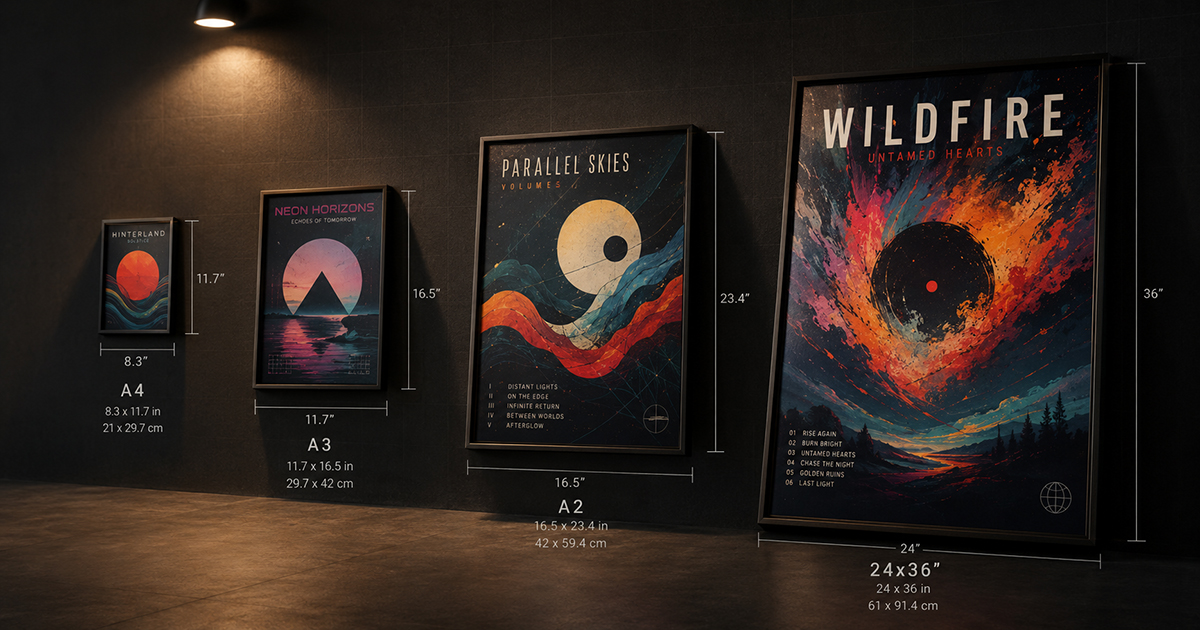
Album Poster Sizes: A Complete Guide (A4 to 24×36)
You've designed the perfect album poster. The layout is right, the fonts are working, the cover art looks great. Now comes the question everyone eventually hits: what size should I actually print it?
Get the size wrong and you end up with a print that's too small to read across the room, or so large it overwhelms the wall. Get it right and the poster looks like it was always meant to be there.
This guide covers every standard poster size from A4 to 24×36 inches — what they look like in the real world, which frames fit them, when to use each, and how to export from your design tool at the right resolution.
The Two Sizing Systems You Need to Know
Poster sizes come in two families:
ISO A-series (used in Europe, Australia, most of Asia)
Based on a mathematical ratio (1:√2) where each size is exactly half the next. A3 is half of A2, A4 is half of A3, and so on. Most European frame manufacturers stock A-series sizes.
Imperial / ANSI (used primarily in the USA)
Based on inch measurements. Standard poster sizes are 11×17, 18×24, and 24×36. These are the sizes you'll find at US print shops and most US frame retailers.
If you're designing in one system and printing in another, you'll need to either crop your design or add bleed margins. More on that below.
Every Standard Poster Size, Explained
A4 — 210 × 297 mm (8.3 × 11.7 inches)
What it looks like: Standard office paper. Smaller than a sheet of newspaper.
Best for:
- Desk display (framed and propped up)
- Bathroom or small nook walls
- Testing a design before printing larger
- Budget printing on any home printer
Frame availability: Extremely common. IKEA RIBBA, Walmart, Target — A4 frames are everywhere and cheap.
Reality check: On a standard bedroom wall, A4 feels small. It works best as part of a gallery wall with multiple prints, or in a compact space like a bathroom shelf or home office desk.
When to use: When you want a quick, affordable print to test how a design looks in the real world, or as part of a multi-poster arrangement.
A3 — 297 × 420 mm (11.7 × 16.5 inches)
What it looks like: Roughly the size of two A4 sheets side by side. Magazine spread size.
Best for:
- Bedroom walls as a solo print
- Gallery walls as a medium piece
- Desk or bookshelf display when framed
- Gifting — substantial enough to feel like a real present
Frame availability: Very common in Europe and Australia. In the US, you'll have slightly more luck finding 12×16 frames, which are close but not exact — plan for a 0.3-inch border or get a custom mat.
Reality check: A3 is the sweet spot for most bedroom situations. Large enough to read from across a standard-sized room, small enough to fit above a desk or beside a window without dominating.
When to use: Your default choice for a first album poster print. If you're unsure what size to order, order A3.
A2 — 420 × 594 mm (16.5 × 23.4 inches)
What it looks like: Four A4 sheets. About the size of a large architectural drawing.
Best for:
- Bedroom feature walls (above the bed, behind the desk)
- Living room walls
- Home studio or music room displays
- Statement pieces
Frame availability: Available from most frame shops and online retailers in Europe. In the US, 18×24 is the closest imperial equivalent (slightly smaller). IKEA stocks A2 frames.
Reality check: A2 makes a genuine statement. At this size, album art detail really shows — the textures in a photograph, the fine lines in an illustration. This is where a great album cover starts to feel like gallery art.
When to use: When you want the poster to be the focal point of a wall. Above a bed, behind a sofa, or on the main wall of a music room.
A1 — 594 × 841 mm (23.4 × 33.1 inches)
What it looks like: Eight A4 sheets. About the size of a large movie poster.
Best for:
- Large feature walls in bedrooms or living rooms
- Home studios and practice spaces
- Hallways and stairwells
- Commercial spaces (cafés, record stores, bars)
Frame availability: Less common in standard retail stores. Most frame shops can order A1 frames; IKEA stocks them. Budget for £30–80 for a basic frame at this size.
Reality check: A1 is genuinely large. Most people don't realize how large until they hold one. Stand at least 1.5–2 meters from the wall to appreciate it properly. At this size, image quality matters significantly — you need at least 150 DPI to avoid visible pixelation, ideally 300 DPI.
When to use: When you want the poster to define the room. One A1 album poster in a music room is a whole design statement.
A0 — 841 × 1189 mm (33.1 × 46.8 inches)
What it looks like: Sixteen A4 sheets. Exhibition poster size.
Best for:
- Large commercial spaces
- Live music venues
- Record stores and music shops
- Statement installations
Frame availability: Specialist frames only. Most people display A0 unframed, mounted with clips, or in purpose-built displays.
Reality check: A0 is not a bedroom size. It's venue size. At this scale, the minimum DPI for acceptable print quality is 150, but 300 DPI is strongly recommended — you'll be standing close enough to see individual pixels otherwise.
When to use: Commercial and venue display, or if you have an unusually large wall and strong design confidence.
11×17 inches — (27.9 × 43.2 cm)
What it looks like: The classic "tabloid" paper size. Standard US concert poster size.
Best for:
- Bedroom walls (solo or gallery)
- Framing with a mat to fill an 18×24 frame
- US print shops (extremely common)
- Concert poster aesthetics
Frame availability: Common in the US. Most craft stores (Michael's, Hobby Lobby) stock 11×17 frames.
Reality check: This is the size most US music fans think of when they say "poster." It's the size of old-school concert flyers scaled up slightly — it has a specific, slightly informal energy that works for rock, punk, and hip-hop aesthetics.
When to use: US-based printing when you want an affordable, widely-available size with a classic poster feel.
18×24 inches — (45.7 × 61 cm)
What it looks like: Close to A2, but slightly larger in the shorter dimension.
Best for:
- Feature wall pieces
- Living rooms and music rooms
- US-based printing (widely available)
- The primary "large poster" size at most US print services
Frame availability: Common at US frame retailers, Walmart, Target, and online. This is the size most US print-on-demand services default to for "large posters."
Reality check: 18×24 is to the US what A2 is to Europe — the serious but practical large size. At this scale, design quality and image resolution both matter. A mediocre layout that looked fine at A4 will show its weaknesses here.
When to use: Your go-to for a US-made large format album poster. Most online print services (Printful, Printify, Vistaprint) treat this as the standard "poster" size.
24×36 inches — (61 × 91.4 cm)
What it looks like: Movie poster size. Two feet wide, three feet tall.
Best for:
- Large feature walls
- Home theaters and music rooms
- High-impact single-poster displays
- Commercial and venue use
Frame availability: Available at major US retailers (Walmart, Target, Amazon), though less common than smaller sizes. Typically $20–60 for a basic frame.
Reality check: This is the size you see in record stores and music venues. It's substantial. Stand 2–3 meters away to view it properly. At 24×36, every design decision is amplified — great type looks spectacular, mediocre type looks sloppy. 300 DPI is not optional at this size — anything less will look visibly pixelated up close.
When to use: When you want to make a statement. One 24×36 album poster in the right spot in a room is a design choice that changes the room.
Quick Reference Table
| Size | Dimensions | Closest Frame | Best Use | Min DPI |
|---|---|---|---|---|
| A4 | 210×297 mm / 8.3×11.7" | A4 standard | Desk, small wall, test | 72 |
| A3 | 297×420 mm / 11.7×16.5" | A3 / 12×16 | Bedroom wall, gift | 150 |
| A2 | 420×594 mm / 16.5×23.4" | A2 / 18×24 | Feature wall | 150 |
| A1 | 594×841 mm / 23.4×33.1" | A1 specialist | Large feature wall | 200 |
| A0 | 841×1189 mm / 33.1×46.8" | Specialist/unframed | Venue, commercial | 150 |
| 11×17" | 279×432 mm | 11×17 US | US bedroom/gallery | 150 |
| 18×24" | 457×610 mm | 18×24 US | US large poster | 150 |
| 24×36" | 610×914 mm | 24×36 US | US statement piece | 300 |
DPI: The Number That Determines Whether Your Poster Looks Good
DPI (dots per inch) is the resolution of your printed file. Higher DPI = more detail = sharper print.
72 DPI — Screen resolution. Looks fine on a monitor, prints blurry at anything larger than postcard size. Use only for digital display.
150 DPI — Acceptable print quality for A3 and smaller when viewed from a normal distance (1–1.5 meters). Visible softness up close at larger sizes.
300 DPI — Professional print standard. Required for A2 and larger to maintain sharpness at normal viewing distances. Mandatory for 24×36.
The math: To print at 300 DPI at 24×36 inches, your image needs to be at least 7200 × 10800 pixels. Most phone screenshots (72 DPI) would need to be upscaled by 4× — which always introduces blur.
This is why designing in a dedicated tool and exporting at the correct resolution matters. A 300 DPI PDF from PosterVibe's Pro plan contains all the pixel data a print shop needs to produce a sharp 24×36 print.
Aspect Ratios: Design Once, Print Anywhere
Most album covers are square (1:1). A standard poster frame is 2:3 (portrait) or 3:4. The mismatch between these ratios is what causes the blank space above and below the album art in many home-printed posters.
PosterVibe handles this with canvas size presets:
| Ratio | Fits | Notes |
|---|---|---|
| 2:3 | A4, A3, A2, A1, A0, 24×36 | Classic poster ratio, most versatile |
| 3:4 | Close to A-series with slight crop | Instagram, some frame sizes |
| 4:5 | Instagram feed posts | Digital only, odd for print |
| 1:1 | Square frames | CD-style, social media |
| 9:16 | Phone wallpaper, Stories | Digital only |
For wall printing, use 2:3. It matches the proportions of standard frames in both ISO and imperial sizing, gives the album cover room to breathe, and leaves space for tracklist, artist name, and other design elements below the artwork.
Frame Buying Guide by Size
For A4 prints
IKEA RIBBA (23×23 cm with mat, or 21×30 without) — £3–5. Any standard frame retailer.
For A3 prints
IKEA RIBBA (30×40 cm) fits A3 with a small mat. Or buy an A3-specific frame. £5–15.
For A2 prints
IKEA YLLEVAD or SILVERHÖJDEN. Alternatively, any frame shop that stocks A2. £10–30.
For A1 prints
IKEA stocks A1 in some markets. Specialist frame shops are more reliable. £20–60.
For 18×24" prints (US)
Walmart, Target, Amazon. Craig Frames and Americanflat stock good options at $15–40.
For 24×36" prints (US)
Target, Walmart, Amazon. Mainstays brand is affordable at $20–30. For better quality, MCS Industries or Americanflat at $40–80.
Common Mistakes to Avoid
Printing at 72 DPI — The single most common mistake. Always export at 150 DPI minimum for print, 300 DPI for anything A2/18×24 or larger.
Designing in the wrong ratio — A 4:5 design won't fit a 2:3 frame without awkward cropping. Choose your canvas ratio before designing, not after.
Forgetting bleed — Print shops add a few millimeters of extra space (bleed) around the edge that gets trimmed. If your design goes to the edge, add 3–5mm of bleed in your export settings. Most designers forget this.
Buying the frame before printing — Always print first and frame second. Slight variations in paper size can mean a print that's 1–2mm off from the stated size, which matters when buying frames.
Ignoring paper weight — Standard 80gsm office paper looks cheap at poster size. Ask for 170–200gsm matte for a proper poster finish.
Export Settings in PosterVibe by Target Size
| Target Size | Plan Needed | Export Format | DPI Setting |
|---|---|---|---|
| A4 / 11×17" (digital) | Free | PNG or JPEG | 72 DPI |
| A4 / 11×17" (print) | Basic | 150 DPI | |
| A3 / 11×17" (print) | Basic | 150 DPI | |
| A2 / 18×24" | Pro | 300 DPI | |
| A1 / 24×36" | Pro | PDF + CMYK | 300 DPI |
| 24×36" (professional print) | Pro | PDF + CMYK + bleed | 300 DPI |
The Short Answer
If you're making one album poster for your bedroom wall and don't want to overthink it:
- In Europe / Australia: Print A3 (297×420 mm), get an A3 frame from IKEA
- In the US: Print 18×24 inches, get an 18×24 frame from Walmart or Target
- Export at: 300 DPI PDF from PosterVibe's Pro plan, or 150 DPI from Basic
That's it. Everything else in this guide is for when you want more control, more scale, or more specific frame compatibility.
Design your album poster and export print-ready →
Frequently Asked Questions
What is the most common poster size?
In Europe, A3 (297×420 mm). In the US, 18×24 inches. Both are widely available in frame retailers and print shops.
What size poster fits a standard IKEA frame?
IKEA's RIBBA frames come in multiple sizes including 21×30 cm (A4), 30×40 cm (A3), 40×50 cm, 50×70 cm, and 61×91 cm (close to 24×36"). All are affordable and widely available.
Can I print a 24×36 poster on a home printer?
Standard home printers print up to A4 or occasionally A3. For 24×36, you'll need a wide-format printer — available at print shops, FedEx/Kinkos, Staples, and online services like Printful.
What DPI do I need for a 24×36 poster?
Minimum 150 DPI for acceptable quality, 300 DPI for professional quality. A 300 DPI file at 24×36 inches is 7200×10800 pixels.
Is A2 the same as 18×24?
Not exactly. A2 is 420×594 mm (16.5×23.4 inches); 18×24 is 457×610 mm. The 18×24 is slightly larger in both dimensions. Most designs will fit both with minor adjustment.
Should I use CMYK or RGB for printing?
Print shops use CMYK. RGB is for screens. If you export in RGB and the print shop converts it, colors may shift — particularly greens and blues. For professional printing, always export in CMYK. Available in PosterVibe's Pro plan.
Ready to Create Your Own?
Put these ideas into practice with our album poster maker, or explore the album cover poster maker, spotify poster maker, tracklist poster maker.